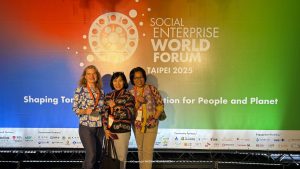
At the end of October, Paula and Lilik Juniarti from the Wadah Foundation and Wadah Cooperative, returned from Taipei, Taiwan, after attending the Social Enterprise World Forum 2025 (SEWF25). This biennial event, that attended by more than 1,000 participants from 73 countries, has successfully brought together the global social enterprise community.
SEWF25 (27-31 October 2025) is a global gathering for the social entrepreneurship community, held this time in Taipei, Taiwan. The forum provides space and opportunity for entrepreneurs, innovators, and changemakers from around the world to connect, learn from each other, and find inspiration.

Opening of SEWF 2025
SEWF, founded in Edinburgh, Scotland in 2008 by Gerry Higgins, has become a leading international organisation dedicated to amplifying the social entrepreneurship movement and advancing to a new economy. This international forum has teams in various countries, including England, Sri Lanka, Portugal, Nigeria, India, the United States, and Scotland.

SEWF 2025 participants in attendance
Three Key Lessons from SEWF25
Paula and Lilik explained that their purpose in attending the event was to absorb trends, innovations, and potential for global social entrepreneurship collaboration. “There are at least three key lessons and blueprints that we brought back from SEWF25 for Wadah,” said Paula and Lilik.

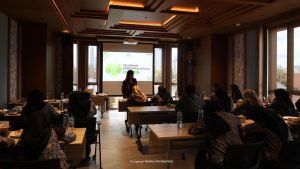
Storytelling blueprint discussion session
The most important lesson is learning how to define a Social Enterprise (SE). An SE must prioritize impact first, with social impact as its primary objective and the main reason for its existence. Economic activities only serve as a means to generate income and profits, which must then be reinvested to expand its social mission.
“During a city tour in the Dadaocheng District, we observed how local resources—traditions, architecture, and culture—were used for urban regeneration,” stated Paula and Lilik. They went on, “This model inspired us to propose the Local Asset-Based Regeneration (LABR) Module.” They believe that this module will help assist the Wadah recognize and leverage their local resources as the core of a new business.
Furthermore, Paula and Lilik mentioned that, through discussions and sharing stories with other participants, they found that the greatest global challenges are a lack of business mindset and limited administrative or financial skills.

Joint discussion session
Innovation of the WUEI Curriculum
To address the lack of a business mindset and limited administration/financial skills, Paula and Lilik proposed innovating or updating the Wadah Universal Education Initiative (WUEI) curriculum with two focuses:
• Designing clear modules to differentiate between a Charity Mindset and a Business Mindset for Impact.
• Providing practical guidance on simple administration (bookkeeping) and how to measure and communicate impact.
The “Wadah Collaboration Space” is a means of continuing the Incubation programme, involving the synergy of three entities, namely the Wadah Foundation (focusing on mentoring), the Wadah Cooperative (providing revolving capital/soft loans) and PT API (acting as a facilitator that provides market access through a retail service model or Retail-as-a-Service).
This program will map the Wadah community according to their readiness to become a SE, ensuring that the support provided is truly in line with the specific scale and needs of each business.
“The experience at SEWF 2025 has given us a clear roadmap,” said Paula and Lilik. “Now is the time for us to unite and move forward together, establishing social entrepreneurship within the Wadah community as a strong and sustainable example,” they concluded.

Paula and Lilik took a photo together with the other participants
Author: Paula Stela Landowero
Editor: Zul Herman